Perc Pineda, PhD
Chief Economist, Plastics Industry Association
The Federal Reserves’ decision to raise rates on September 16, 2026, was based primarily on concerns of persistent inflation. The Federal Open Market Committee (FOMC) noted that job gains have kept pace with the workforce, and the unemployment rate has changed little. This statement was confirmed by the Bureau of Labor Statistics (BLS) in its September jobs report showing little change in the unemployment rate from 4.1 percent in July and August, to 4.2 percent in September.
Weaker Jobs Growth
Concerns about weaker job growth were widespread after the BLS estimated that the economy added only 29,000 nonfarm payroll jobs—employment outside the agricultural sector—in September. Compared with the 133,000 jobs added in August, the September release could easily be interpreted as a sign of a faltering labor market. Looking beyond the noisy monthly data, however, the U.S. labor market appears to remain stable.
Following a loss of 10,000 nonfarm payroll jobs in July and the gain of 133,000 in August, the U.S. economy added a total of 152,000 jobs in the third quarter, albeit the slowest quarterly gain in 2026. By comparison, 218,000 and 242,000 jobs were added in the first and second quarters, respectively. The moderation in job growth is consistent with the broader downward trend in monthly changes in total nonfarm employment over the past five years, but it does not necessarily indicate a faltering labor market.
Plastics Manufacturing Employment
While the 2.9 percent unemployment rate in the manufacturing sector remains well below the overall unemployment rate, the monthly increase in manufacturing employment slowed to 9,000 in September, compared with 20,000 in July and 15,000 in August. Despite the slower monthly gains, manufacturing employment increased by 44,000 in the third quarter, its largest quarterly increase so far this year. Durable goods manufacturing accounted for most of the September increase, adding 8,000 jobs, compared with 1,000 in nondurable goods manufacturing.
Within nondurable goods manufacturing, plastics and rubber products led employment growth, adding 4,600 jobs, while most other sectors posted modest gains or declines. The unemployment rate in plastics and rubber products manufacturing fell to 1.7 percent in September, from 5.5 percent in July and 4.5 percent in August. So far this year, the unemployment rate in plastics and rubber products manufacturing has fluctuated between a low of 0.9 percent and a high of 5.5 percent
Labor Market Outlook
In the Summary of Economic Projections released following the FOMC meeting on September 15–16, 2026, the median projections for the unemployment rate in 2026 and 2027 were revised downward, from 4.3 percent to 4.1 percent in 2026 and from 4.3 percent to 4.1 percent in 2027. The revisions suggest a more favorable outlook for the labor market. Similarly, the Federal Reserve Bank of Philadelphia’s Survey of Professional Forecasters revised its median unemployment rate forecast downward, from 4.4 percent to 4.3 percent for 2026 and from 4.5 percent to 4.3 percent for 2027. Both outlooks suggest that labor market conditions are expected to remain stable. With the economy at or close to full employment, a significant acceleration in job growth is unlikely. At the same time, the U.S. economy has been growing above trend since the second quarter of 2021.
Career Opportunities in Plastics Industry
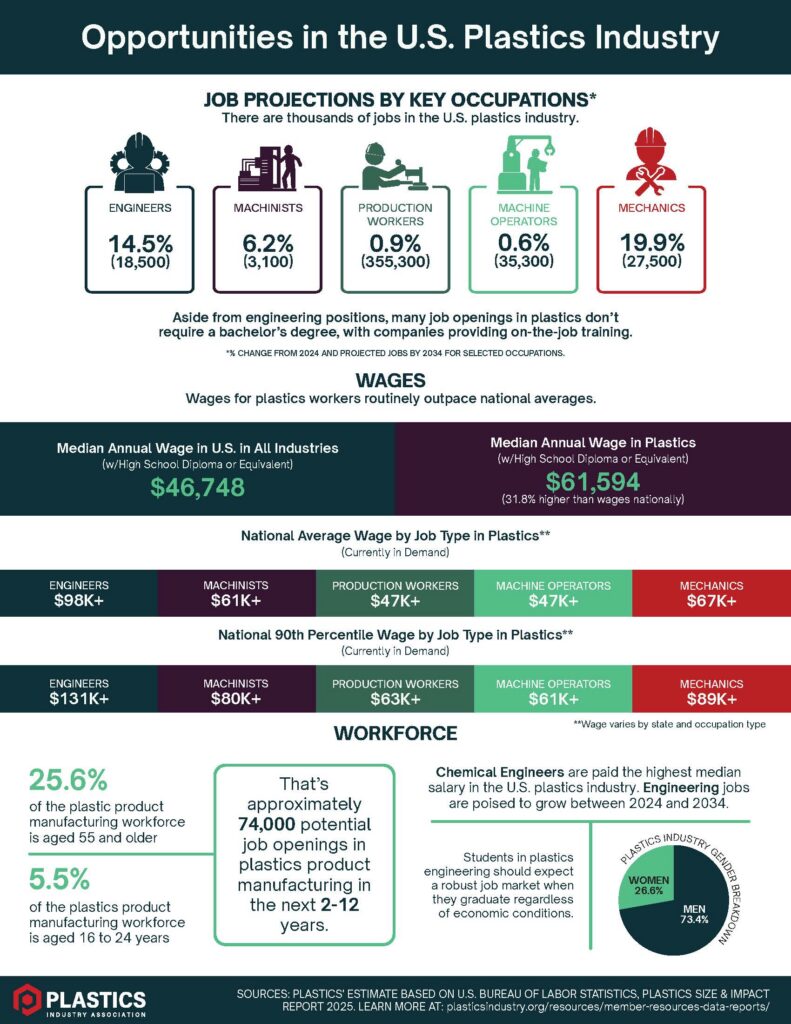
Each year on Manufacturing Day, the Plastics Industry Association releases its Opportunities in the U.S. Plastics Industry estimate.[1] The report projects a 14.5 percent increase in engineering jobs in the plastics industry through 2034 and a 22.0 percent increase in mechanic jobs over the same period.
[1] See https://www.plasticsindustry.org/resource/career-opportunities-in-plastics/