
February 16, 2026

Growing demand for efficiency, sustainability, and precision is reshaping how manufacturers approach material handling and production workflows. Sustainable plastic trays are emerging as essential tools in modern manufacturing, bridging operational needs with environmental responsibility.
The next generation of trays offers performance advantages that streamline processes, reduce waste, and support automation in ways that align with productivity and sustainability objectives.
The use of stackable and reusable plastic trays is transforming how factories organize production lines and supply logistics.
Trays designed for repeated use minimize downtime during changeovers, simplify product transfers, and maintain consistent protection for components throughout production. Companies seeking higher output rates are turning toward these solutions to standardize material flow and maintain traceability across increasingly automated facilities.
Manufacturers in sectors such as automotive, electronics, and pharmaceuticals rely on trays that can withstand frequent handling while maintaining their shape and structural integrity. Their compatibility with robotic systems allows for faster loading, sorting, and transport, reducing reliance on manual labor and improving accuracy.
The result is a smoother production cycle where materials move more efficiently and overall throughput increases without sacrificing safety or quality control.
Sustainable plastic trays are advancing through improvements in polymer science, with polypropylene (PP) remaining one of the most preferred materials for this purpose. Offering both strength and lightness, along with the advantage of recyclability, it meets the performance demands of modern industry.
PP’s chemical resistance and ability to maintain stability under high temperatures allow it to perform reliably in demanding environments such as food processing or precision electronics assembly.
A growing number of manufacturers are incorporating recycled PP into new trays, closing the loop between production and reuse. The long service life of these trays significantly reduces waste generation while offering durability that traditional packaging materials cannot match.
Many facilities have found that reusing trays across production cycles reduces procurement costs and waste management expenses.
Polymer flexibility allows for design modifications that accommodate specific operational requirements. Smooth surfaces for sanitary applications, conductive materials for electronic parts, or reinforced edges for automated handling can all be achieved with minimal tooling adjustments.
These customization options have allowed tray producers to supply solutions optimized for the growing integration of robotics and smart tracking systems within modern manufacturing lines.
Sustainability has shifted from a compliance consideration to a defining factor of operational strategy. Trays engineered for reuse and built from recyclable materials help significantly lower waste and resource consumption. Companies are increasingly aligning these efforts with broader corporate carbon reduction and circularity goals.
Programs such as Recycling is Real and Zero Net Waste demonstrate how industry associations and manufacturers collaborate to promote recycling infrastructure and responsible product design. The shift toward circular manufacturing models positions plastic trays as part of an ongoing system rather than a disposable resource.
As environmental regulations continue to strengthen worldwide, sustainable trays provide manufacturers with a practical route to meeting expectations without compromising efficiency.
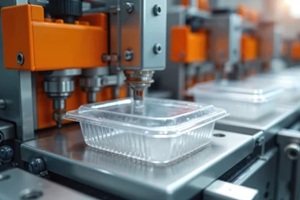
The food and beverage industry illustrates how material innovation directly enhances productivity.
Trays built for hygienic applications maintain product integrity throughout processing and transport while reducing cleaning requirements. Facilities operating under strict regulatory standards use trays that resist moisture and chemical corrosion, helping maintain compliance with food safety laws.
Automation-ready trays are particularly valuable in high-volume production. Their uniform dimensions and stable stacking characteristics allow conveyor belts and robotic handlers to operate at consistent speeds without interruption.
As labor shortages continue to challenge manufacturers, maintaining throughput with minimal manual oversight becomes increasingly essential.
North America remains a major center for sustainable tray manufacturing, supported by rising investment in automated warehousing and distribution systems.
U.S. companies are adopting trays customized for smart inventory management, integrating RFID technology for real-time visibility across supply chains. These advancements improve coordination between production sites and logistics hubs, helping reduce inefficiencies linked to tracking errors or misplaced materials.
In Europe, environmental policy has accelerated the adoption of recyclable plastics in industrial packaging. Introducing closed-loop reuse systems in markets such as Germany and the Netherlands demonstrates how sustainability can drive innovation and long-term cost savings.
Meanwhile, Asia-Pacific countries are seeing rapid growth as manufacturers invest in automation and energy-efficient production processes, aligning industrial modernization with sustainability initiatives.
Manufacturers continue to encounter challenges related to recycling infrastructure, rising material costs, and complex compliance requirements.
Even with ongoing challenges, advances in tray engineering have opened fresh possibilities for process efficiency. Companies are rethinking how they handle materials throughout their life cycle, emphasizing durability, recyclability, and modularity as design priorities.
Collaboration between equipment suppliers, recyclers, and materials scientists has accelerated improvements in production efficiency and product recovery. Advances in mono-material tray construction simplify recycling and reduce contamination risks, strengthening the link between sustainability goals and operational reliability.
The outcome is a packaging ecosystem capable of supporting long-term circularity while meeting manufacturing performance standards.
Manufacturing environments are increasingly dynamic, and sustainable plastic trays are well-positioned to support this shift.
Lightweight polymers, improved stacking mechanisms, and embedded digital tracking systems will continue influencing how materials are stored and transported. As automation deepens and digital supply networks expand, trays will serve as functional tools and data carriers that enhance visibility across every production stage.
Manufacturers pursuing efficiency and sustainability in equal measure find that plastic trays represent a practical intersection of both goals. Their contributions to waste reduction, operational efficiency, and compliance readiness make them indispensable to the modern production framework.

The success of sustainable manufacturing relies on ongoing collaboration among material suppliers, processors, and recyclers. Unified efforts to expand recycling access, standardize best practices, and advance product innovation build a stronger foundation for responsible growth within the plastics industry.
To stay informed about emerging technologies, policy developments, and sustainability programs transforming plastics manufacturing, consider joining PLASTICS, the Plastics Industry Association. Membership connects businesses with market intelligence, advocacy resources, and collaborative opportunities that support operational efficiency and long-term environmental progress.
PLASTICS and the Future Leaders in Plastics (FLiP) Committee are devoted to supporting and encouraging the next generation of plastics leaders who will play a crucial role in the innovation, technology and future of the plastics industry. FLiP’s mission is to provide young professionals under the age of 40 the exposure, education and resources they need to build lifelong careers in plastics. Want to join? Want to get your employees involved? Email: flip@plasticsindustry.org
