
March 16, 2026

The growing demand for sustainable materials has prompted manufacturers, policymakers, and consumers to seek more effective ways to manage plastic use.
A hybrid approach combining renewable, plant-based content with conventional polymers provides a practical solution that enhances sustainability efforts while maintaining performance, consistency, and manufacturing efficiency.
Recycling has long been positioned as a beneficial primary solution to plastic waste. The process recaptures material value and helps reduce environmental pressures from plastic waste produced each year.
Alternative materials, particularly paper-based or fiber-derived substitutes, have gained attention as potential replacements. They often appeal to consumers seeking options perceived as natural.
Renewable sources, however, are not automatically low-impact. Producing paper, aluminum, or glass typically requires significant energy inputs, large amounts of water, or intensive extraction steps.
When combined with performance limitations, the overall environmental profile can appear less favorable than expected. Plastic frequently remains the most efficient choice for food protection, medical applications, and durable consumer goods.
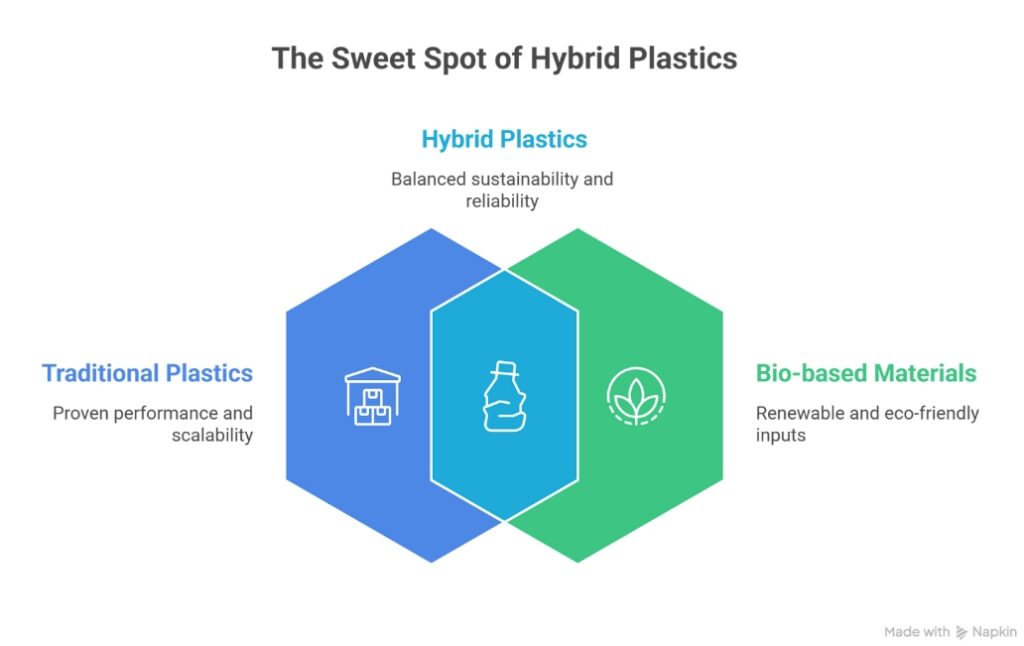
A hybrid approach introduces renewable, bio-based content into traditional plastics in a measured and gradual manner.
Manufacturers can adjust blend ratios, test performance traits, and scale at a pace that matches commercial, regulatory, and logistical demands. The approach prioritizes continuous improvement over abrupt transitions that may strain supply chains or lead to unintended consequences.
Hybrid materials deliver several advantages that work well within existing production environments, including:
Industries that rely on highly controlled material behavior, such as food packaging, medical devices, or electronic components, require predictability.
Hybrid plastics retain the protective qualities and strength that industries require, enabling manufacturers to be more sustainable without compromising dependability. This balanced approach gives companies more confidence to test bio-based content and build internal knowledge.
Hybrid design aligns with real-world economic forces and accelerates progress toward sustainability targets. It positions producers to respond to regulatory expectations, consumer preferences, and long-term resource constraints in a practical way.
Companies can begin with small pilot projects, measure outcomes, and expand once data support broader implementation, reducing uncertainty and helping teams refine formulations.
Successful pilots often build internal momentum, and positive results can support broader corporate initiatives centered on sustainability.
Consumer interest in lower-impact materials continues to grow. Hybrid plastics offer superior environmental performance compared to fully fossil-based polymers while maintaining durability and shelf stability.
That balance supports responsible production without requiring users to adjust how they handle or dispose of packaging.
Introducing renewable feedstocks creates demand for agricultural inputs, biomass processing, and supportive logistics. The development encourages investment in rural regions and helps diversify the sources that supply large material manufacturers.
Gradual adoption gives growers, processors, and distributors time to build capacity and scale sustainably.
Efforts to improve plastic sustainability require a combination of solutions. Recycling remains valuable, and alternative materials will continue to play roles in areas where they truly outperform plastics.
A hybrid approach complements these strategies rather than replacing them, which creates a more resilient system. Manufacturers can maintain their established infrastructure while steadily reducing their dependence on fossil fuels and microplastic production.
Materials function within complex networks that include design, production, logistics, and end-of-life management.
Hybrid plastics work within these networks by providing environmental benefits without destabilizing operations. They represent an approach grounded in realistic timelines and measurable improvements.
Sustainable plastics require continuous refinement, fresh thinking, and practical solutions that align with the way global industries operate.
Hybrid materials offer a path grounded in scientific progress, manufacturing experience, and environmental responsibility. They help lower the carbon footprint of plastics, reduce reliance on fossil inputs, and strengthen circularity, all while maintaining the material performance that modern life depends on.
Organizations working to strengthen sustainability efforts, improve recycling outcomes, and advance material innovation can benefit from the Plastics Industry Association’s advocacy, research, and supply-chain engagement.
Upon joining, members gain access to policy insights, technical guidance, industry events, and collaborative initiatives that support responsible growth and long-term competitiveness.
PLASTICS and the Future Leaders in Plastics (FLiP) Committee are devoted to supporting and encouraging the next generation of plastics leaders who will play a crucial role in the innovation, technology and future of the plastics industry. FLiP’s mission is to provide young professionals under the age of 40 the exposure, education and resources they need to build lifelong careers in plastics. Want to join? Want to get your employees involved? Email: flip@plasticsindustry.org
