Perc Pineda, PhD
Chief Economist, PLASTICS
Payroll employment in the U.S. fell by 92,000 jobs in February, while the unemployment rate edged up from 4.3% in January to 4.4%, raising concerns about the strength of the labor market. The February 2026 Employment Situation report from the Bureau of Labor Statistics shows the decline was broad-based across sectors. The private services sector recorded the largest drop (–61,000), followed by the private goods-producing sector (–25,000), while government employment declined by 6,000. Against the backdrop of an increase in the number of unemployed persons by 203,000, the civilian labor force rose by 18,000 and those not in the labor force—those neither working nor looking for work—increased by 72,000. Contributing factors frequently cited in media reports for the February employment decline include a major healthcare strike, adverse winter weather conditions, and lingering tariff-related uncertainty.
Key factors contributing to the decline
Healthcare employment fell sharply because tens of thousands of workers were off payroll during the strike period. Harsh winter conditions disrupted construction, leisure/hospitality, and other outdoor industries, temporarily reducing employment in February and likely pushing some hiring into March. The Blizzard of February 22–23, 2026, was one of the most disruptive winter storms in recent years, with statewide travel bans and emergency declarations across multiple Northeast states. Lingering uncertainty around tariffs also contributed to a pause in hiring. In 2025, importers and distributors absorbed the cost of higher tariffs because contracts set purchasing prices, compressing profit margins. Any hiring plans for 2026 now take these higher costs into account.
Revisions, volatility, and lagging indicator
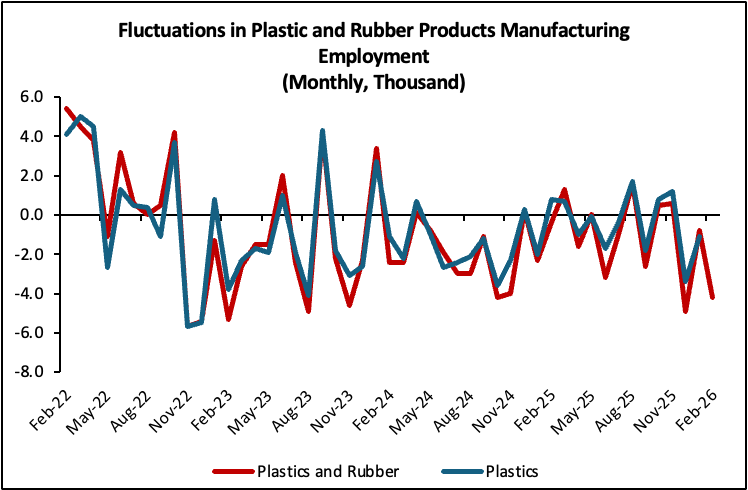
There are basic considerations when analyzing macroeconomic data. Firstly, monthly data is noisy, and jobs numbers are subject to revision. The February report shows that plastics and rubber products manufacturing employment fell by 4,200 jobs, while the unemployment rate in this sector rose from 1.1% in January to 1.9% in February. Monthly changes in plastic products manufacturing have been volatile, as shown in the accompanying graphic. The February jobs and production data for plastics alone are yet to be released, but trends in recent periods are consistent with the observed fluctuations.
Secondly, noisy monthly data often leads to subsequent revisions as better estimates or additional information become available. December and January payroll employment were revised downward by 65,000 and 4,000, respectively, suggesting that labor markets were less robust than previously estimated.
Thirdly, employment data are lagging indicators. February’s numbers, for example, would not reflect March developments such as geopolitical events or the Supreme Court’s February 20th decision invalidating IEEPA tariffs, which temporarily reinstated 10% global tariffs for 150 days. These events would have limited effect on February hiring.
Job losses outweigh gains in February amid short-term disruptions
Overall, the drop in February employment was primarily caused by temporary disruptions rather than a collapse of the U.S. labor market. Slowing growth following the post-Covid surge has been noted and accounted for in the payroll employment outlook. February’s numbers still suggest underlying strength in business and consumer spending. Wholesale (B2B) and retail trade (B2C) sectors added 6,000 and 2,300 payrolls, respectively, indicating that both sectors recognize robust demand. Additionally, gains in financial services (+10,000), air transportation (+5,100), and professional, scientific, and technical services (+11,000), while partially offset by declines elsewhere, support the argument that the labor market has not collapsed. However, a significant uptick in unemployment or sustained broad-based job losses in the coming months would raise greater concerns about the labor market’s trajectory.
Despite widespread discussion, the February report indicates that artificial intelligence has not yet constrained hiring, and its influence on upcoming employment data remains unclear. Overall, the February 2026 employment numbers still suggest underlying strength in the U.S. economy.