Perc Pineda, PhD
Chief Economist, Plastics Industry Association
On July 20, 2026, President Trump issued a proclamation under Section 338 of the Tariff Act of 1930, imposing an additional 50% ad valorem duty on a wide range of Canadian products. This includes approximately 20 HTS codes covering plastic materials and plastic products. The action responds to Canada’s tariffs on U.S. motor vehicles, which the President determined impose an unreasonable burden on U.S. commerce while favoring imports from other countries.
Section 338 authorizes the President to impose duties of up to 50% when a foreign country discriminates against or places an unreasonable burden on U.S. commerce. The new tariffs take effect on August 19, 2026, and are intended to encourage Canada to remove these measures against American vehicles and auto parts.
Scope of the Tariff Action
While the proclamation identifies products by 8-digit HTS codes in its annexes, the product descriptions serve informational purposes only and do not limit the scope of the Section 338 action. In other words, any listed 6-digit or 8-digit HTS code encompasses all 10-digit HTS codes that fall under it. The complete lists of affected products appear in Annex l and Annex ll.
Trade Data Tells the Story
U.S. imports of plastics subject to the new 50% tariffs from Canada totaled approximately $2.99 billion in 2023, $3.09 billion in 2024, and $3.10 billion in 2025, based on Customs values.
Industry observers may worry that the cumulative effect of tariffs—the new 50% tariffs on Canadian imports, Section 301 tariffs targeting imports from certain countries to address forced labor, and Section 232 tariffs—would increase manufacturing costs.* The extent of any price effects, however, will depend on manufacturers’ ability to adjust their sourcing strategies, absorb higher input costs, and secure alternative sources of supply. While higher tariffs have cost implications, the United States is a major producer of these plastics, as reflected in its strong export performance.
In 2025, U.S. exports of the same plastics to Canada reached $4.65 billion on a Free Alongside Ship (FAS) value basis, generating a $1.55 billion trade surplus. Exports totaled $4.74 billion in 2024 and $4.75 billion in 2023. Globally, U.S. exports of these plastics reached $16.3 billion in 2025 (FAS value). Taken together, these figures indicate substantial domestic production capacity, supplemented by imports from other trading partners.
Enhancing the USMCA for North American Plastics Trade
Despite the U.S.-Mexico-Canada Agreement (USMCA), the bilateral plastics trade relationship between the United States and Canada has room for improvement. The United States continues to import more plastics from Canada than it exports, highlighting opportunities to strengthen trade under a modernized USMCA. The plastics industries in all three countries have benefited substantially from the agreement’s tightly integrated manufacturing supply chains, which depend heavily on plastics for capital goods and intermediate inputs. Maintaining strong market access across these supply chains remains essential.
That said, the agreement is now under review and can be strengthened. Potential enhancements include updating rules of origin to better protect benefits for USMCA partners from non-member countries and expanding coverage to Canadian agriculture, which relies extensively on plastic packaging and related products.
Plastics Trade Reflects Different North American Dynamics
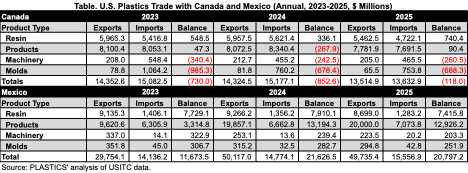
Data from the past three years show that trade outcomes with the United States’ North American partners under the USMCA framework have differed, reflecting the distinct characteristics of the U.S. plastics industry supply chain. Imports of plastics machinery complement U.S. domestic production by providing manufacturers with access to specialized equipment to maintain competitiveness. U.S. moldmakers have the capacity to support greater domestic production of molds.
The United States has maintained a trade surplus with Mexico in plastics while recording a trade deficit with Canada, reflecting differences in industrial capabilities, production structures, and market demand across the two trading partners, as shown below.
Key Takeaway
The new Section 338 tariffs represent a targeted response to Canada’s automotive trade measures. Because the United States maintains strong domestic production and a trade surplus with Canada in the affected plastics categories, the risk of broad supply disruptions appears limited. At the same time, the ongoing USMCA review presents an opportunity to address remaining trade imbalances and reinforce the competitiveness of North America’s integrated plastics supply chains.
*USMCA-compliant products and all articles subject to Section 232 tariffs are not subject to the new Section 301 tariffs addressing forced labor.